From imported evidence to validation, change control and production readiness.
A practical engineering model for importing new product introduction evidence, reconciling configurations, planning validation and releasing an approved baseline. The paper specifies the records, handoffs and decision gates that turn a collection of files into a reviewable readiness package.
Edition 3.2.1 · October 2026 · 15 pages
For engineering managers, validation leads and new product introduction teams
A test marked complete is not the same as accepted evidence for the configuration being released.
01 / INDUSTRY PERSPECTIVE / 2026
Keep engineering and operating records connected.
IEA reports 1.2 TWh of EV battery deployment in 2025, nearly 30% growth, and more than 4 TWh of nameplate cell capacity. LFP exceeded 55% of EV battery deployment. [1]
Readiness must follow the configuration
Our interpretation: changing cells, materials or process routes creates new applicability questions even when nominal specifications match. An new product introduction baseline should identify which evidence transfers, which assumptions changed and who approved the reuse. The release gate then evaluates evidence against the actual target configuration.
A faster launch needs a better evidence handover
Importing reports can accelerate preparation only if requirement IDs, sample histories and versions reconcile. Measure how quickly the team reaches an accepted evidence package, including time spent resolving conflicts. A large number of imported records is a weak proxy for readiness.
Validation should preserve both coverage and learning
Use production and service findings to challenge the validation plan. An unexplained result may reveal a missing operating condition, an unreliable method or a configuration mismatch. Record that learning as a controlled change to coverage, with an owner and a reason, so future programs can retrieve it.
02 / TESLA STORY / PUBLIC CONTEXT & SOLUTION ORIGIN
Tesla makes the lifecycle connection tangible.
Tesla describes battery cell and pack R&D, vehicle and storage products, connected service and remote diagnostics in its 2025 Form 10-K. It deployed 46.7 GWh of energy storage in 2025. [2]
Why this background matters
Our interpretation: a business that combines batteries, manufacturing, connected products and service needs to understand a unit across successive operating contexts. A supplier or test-method change can become relevant again when a field symptom appears. The central engineering question is how to preserve that evidence and its configuration history.
The origin of our Battery solution story
The supplied Tesla Battery Lifecycle Intelligence Platform presentation organizes the opportunity around supplier intelligence, new product introduction, manufacturing, equipment, battery health, service, remanufacturing and reusable knowledge. Its proposed foundation links source signals to analysis and reviewed actions. This publication carries that lifecycle structure into a clearer engineering and operations solution.
The scenario we can demonstrate
A changed test program and a new cell lot coincide with a final-test rejection spike. The AI Engineer assembles the evidence, keeps alternative causes visible and helps the team prepare a controlled comparison. Engineers then review the correction, release scope and follow-up checks. The investigation, validation and change-approval example later in this paper shows this sequence using fictional records.
The boundary of the story
The supplied deck labels itself a discussion demo with sample data. It does not establish an accepted Tesla deployment, an independently verified outcome or endorsement. We present the architecture as a proposed solution for this lifecycle context. Project-specific achievements require a confirmed, publishable customer record.
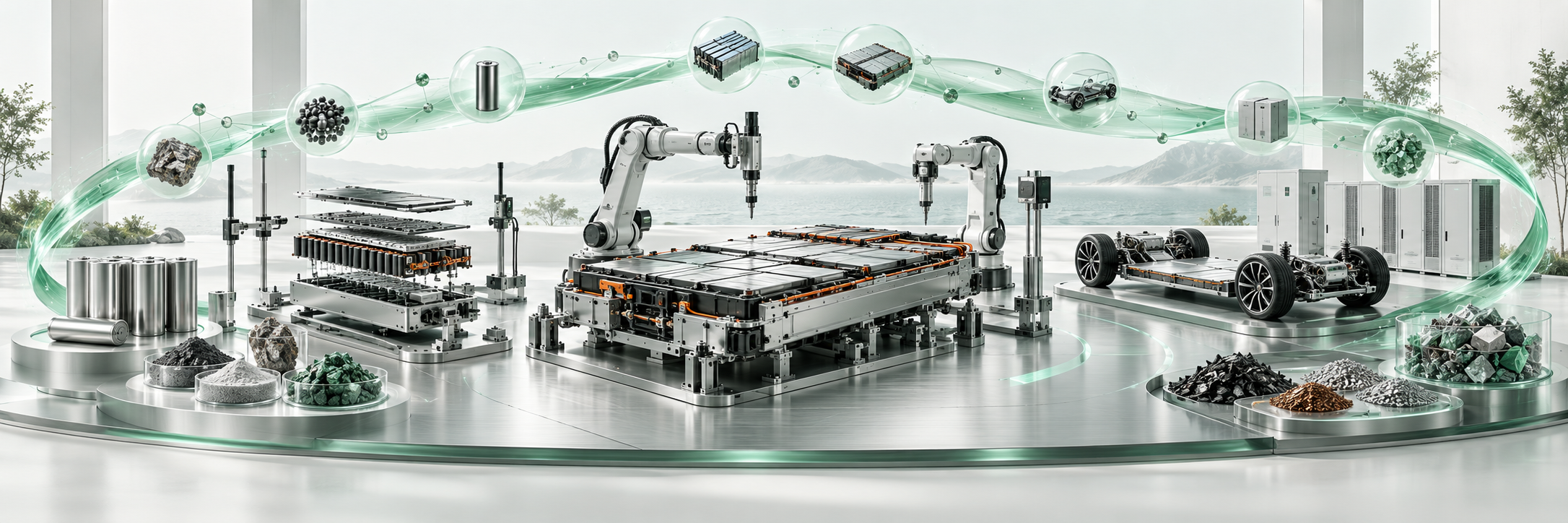
The lifecycle view connects the work of engineering, operations and service teams while retaining the source evidence behind each decision.
Concept illustration: connected engineering, manufacturing, service and recovery. No customer facility is depicted.
A shared foundation with several forms of analysis
The proposed system links product identity, configurations, material production history, test results and service events. On that foundation, the AI Engineer combines evidence retrieval, population comparison, time-series analysis and hypothesis tracking. Health and recovery models require their own agreed data, evaluation and technical scope.
Human decisions close the loop
Engineering accepts validation evidence. Quality approves containment and decision on affected units. Service engineers select approved diagnostic procedures. Change owners release governing versions. The resulting decision and effectiveness check return to a reusable knowledge layer, so the next team can see what worked and under which conditions.
Lifecycle stage
AI-supported work
Reviewable output
Supplier & new product introduction
Compare lots; reconcile imported evidence
Qualification scope and gate report
Production & testing
Relate process variation to raw test evidence
root cause analysis and validation package
Field & recovery
Connect symptoms to history and prior learning
Diagnostic case; scoped recovery review
04 / ENGINEERING MANAGEMENT
Check what is ready and what is missing.
Battery development creates many artifacts: specifications, design revisions, test plans, sample builds and review records. The challenge is knowing which evidence applies to the configuration being considered for release.
Technical readiness and project progress
A milestone view should identify open technical issues alongside dates and task completion. A design can be on schedule while its validation coverage remains incomplete. The workspace makes both states visible so that a project review can address the actual blocker.
A connected engineering record
Use a common relationship model for requirement, design object, revision, risk, sample, test, result and decision. Assign ownership and source references to each object. Track proposed, reviewed, accepted and superseded states separately.
Decisions with explicit limits
A readiness assessment should state which product configuration and operating conditions the evidence supports. Open deviations, untested conditions and accepted risks remain visible in the approval package. The responsible engineers approve the decision on affected units.
Question
Evidence to inspect
What must be met?
Approved requirement and acceptance criterion
What has changed?
Configuration comparison and impact record
What has been proven?
Accepted result linked to sample and conditions
What prevents release?
Open risks, missing evidence and accountable owners
05 / NEW PRODUCT / RECORDS & READINESS
Review the records for a new product.
Importing files is the start of a readiness workflow. The useful outcome is an accepted map of what must be proven, which configuration it applies to and who will close each remaining gap.
Import
Reconcile
Validate
Review gate
Handover
Import with source history
Start with the product/parts list baseline, cell and supplier qualification records, requirement set, validation plan and representative pilot-build results. Retain each source file revision, sheet or clause location, owner and import date. Extracted fields are candidates until reviewed. Put conflicting units, ambiguous part numbers and duplicate requirements into an exception queue.
Reconcile before assessing readiness
Map supplier and internal part identifiers explicitly. Separate the intended production baseline from the configuration actually built in the pilot. Link samples to cell lots, process routes, test versions and deviations. A passed result for a different configuration is reusable evidence only after an engineer documents why the transfer is justified.
Build the gate around decisions
Present blocking gaps, accepted exceptions and completed evidence separately. Assign one accountable owner and due action per gap. At the gate, retain the accepted release scope and the authority that approved it. Operations should be able to retrieve the governing test and process versions from the handover, not just receive a folder of reports.
Gate package
Readiness question
Acceptance record
Imported baseline
Are identities and revisions reconciled?
Reviewed mapping + exceptions
Pilot evidence
Does evidence cover the release configuration?
Coverage + deviations
Production handover
Can the line use the approved versions?
Owner acceptance + access check
06 / REQUIREMENTS & REVIEW
Give each requirement a clear test.
The requirements baseline should explain what must be achieved, where the requirement applies and how the team will determine acceptance. Automated extraction is a starting point for review, not an approval.
Requirement
Criterion
Sample
Result
Acceptance
Create the baseline
Extract candidate requirements from customer specifications and internal documents. Preserve the original clause, document revision and source location. Resolve ambiguous wording, duplicated requirements and inconsistent acceptance criteria with the accountable engineer.
Connect each requirement to acceptance
Record the measurable acceptance criterion, verification method, applicable configuration and accountable reviewer. If a criterion is ambiguous, route it for clarification before treating the validation task as ready. Keep applicability and any reuse rationale explicit when prior evidence is carried into a new new product introduction baseline.
Keep gaps open until evidence is accepted
Close a coverage gap only when the required evidence is reviewed against the accepted criterion. A new drawing, uploaded report or completed test alone does not establish readiness. Link the accepted result to the exact configuration and retain deviations, rejected evidence and reviewer rationale.
Required field
Why it matters
Source and revision
Makes the governing requirement recoverable
Owner and applicability
Defines responsibility and affected configuration
Acceptance and method
Makes verification criteria explicit
Evidence and decision on affected units
Records what supports acceptance
07 / CONFIGURATION & CHANGE
Trace the impact before release.
Supplier, material, hardware, process and test-method changes can affect different parts of the validation plan. An impact review should connect the proposed change to both engineering artifacts and the production population.
Compare controlled baselines
Show the old and proposed configuration with source revisions. Distinguish the changed object from its dependent objects. For example, a new cell may require review of interfaces, operating assumptions, manufacturing parameters and test coverage; the actual scope is determined by engineering.
Define the verification scope
Retrieve relevant requirements, prior qualification evidence and known failure modes. Suggest candidate verification tasks with a reason for each. The reviewer decides which tasks are necessary, which evidence can be reused and where additional information is required.
Control effectiveness and handover
Record approval, effective date or serial range, implementation owner and required communications. Confirm that operations uses the approved process and test versions. Preserve historical configurations so that later field or manufacturing issues can be interpreted correctly.
Change record
Review question
Affected objects
Which parts, versions, documents and processes change?
Affected evidence
Which previous results remain applicable?
Required verification
What must be demonstrated before effectiveness?
Effective scope
Which builds, lots or serials use the change?
08 / VALIDATION MANAGEMENT
See which requirements have been tested.
A test result is useful only with its configuration and conditions. The proposed validation workspace links plans, samples, execution records, deviations and engineering acceptance so that the team can inspect coverage directly.
Plan around requirements and risks
Map each validation task to an acceptance criterion and the requirement or risk it addresses. Record planned sample configuration and test conditions. Group related tasks for practical execution without losing the individual coverage relationships.
Preserve execution context
Store sample identity and production history, equipment identification, method and program versions, conditions, timestamps and original results. If a deviation occurs, record it with an engineering decision on affected units. Preserve failed and repeated tests rather than retaining only the final successful result.
Assess the evidence
Provide views of planned, executed, reviewed and accepted coverage. Highlight requirements with no accepted evidence and results whose configurations differ from the target release. The coverage matrix supports review; it does not replace technical judgment.
Coverage state
Meaning
Planned
A defined task is linked to a requirement
Executed
The original result and conditions are recorded
Reviewed
An engineer assessed the result and deviations
Accepted
The evidence supports the applicable criterion
09 / PROCESS VALIDATION / WORKED PROTOCOL
Make the comparison reproducible.
A validation record should allow another engineer to reconstruct the conditions, assess the conclusion and identify what the experiment does not establish.
Define the unit of comparison
For the validation study, select 12 independently qualified known-good packs with both cell lots represented. Run every pack on both Station 1 and Station 2 using v2.3, v2.4 and v2.5. This creates 72 runs but only 12 distinct packs; repeated runs must not be reported as 72 independent product samples.
Control execution and acceptance
Record temperature, state of charge, fixture setup, calibration state and program checksums. Specify sequencing, stabilization and treatment of interrupted runs before testing. Retain the entire response curve and sampling timestamp. The illustrative criterion is no false rejects on these qualified references and no unexplained shift in the accepted measurement window.
Interpret within the tested scope
The pattern follows v2.4 on both stations and disappears when the wait before measurement is restored. That supports the measurement-method explanation within this sample. It does not prove performance across every product, environment or fault condition. Add sensitivity checks using approved challenge samples before a broader release; an apparent reduction in rejection must not conceal real faults.
Station / known-good packs
v2.3 baseline
v2.4 suspect
v2.5 corrected
Station 1 / same 12
0 / 12
6 / 12
0 / 12
Station 2 / same 12
0 / 12
6 / 12
0 / 12
10 / NEW PRODUCT & PRODUCTION HANDOVER
Prepare a clear production handover.
new product introduction brings design, supplier, manufacturing and test evidence together. The goal is an explicit decision about the next stage and a usable handover for the team receiving the product.
Compare behavior as well as specifications
For a new cell, supplier, material or process route, compare the available behavior with an approved baseline. Consider distribution differences and the conditions under which data was generated. A matching specification alone does not resolve every qualification question.
Build the readiness review
Assemble accepted validation results, unresolved issues, process and test readiness information and the current configuration baseline. Identify blocking issues separately from risks accepted by the responsible authority. State the limits of the proposed release.
Agree the operating handover
Transfer the approved design and parts list, critical characteristics, applicable process and test requirements, control responsibilities and issue escalation route. Confirm access to the evidence and governing versions, rather than simply sending a collection of files.
Handover item
Receiving-team check
Configuration baseline
Approved version is available and identifiable
Test requirements
Method, limits and version are controlled
Open risks
Owner, decision on affected units and follow-up are explicit
Operating feedback
Incidents can be linked back to engineering objects
11 / WORKED EXAMPLE / INVESTIGATE, TEST AND APPROVE
From a failed test to a controlled release.
A new cell lot and a changed final testing program arrive in the same production window. The team must distinguish a product issue from a test-method issue before changing the release decision.
Detect
root cause analysis
Validate
Change
Verify
01 / Detect and contain
In this fictional example, 24 of 240 packs are rejected on first test. Each of three stations tests 80 packs: Station 1 flags 3, Station 2 flags 18 and Station 3 flags 3. Quality opens the test-failure investigation, preserves the original results and reviews the affected serials. Containment is a temporary decision on affected units, not proof of the cause.
02 / Investigate the competing explanations
Both cell lots show 12 rejects out of 120 packs. By program version, v2.3 shows 4/120 and v2.4 shows 20/120. This redirects attention to measurement, but the observational groups may differ. Raw traces suggest that v2.4 samples before the response has settled; a matched test is still required.
03 / Validate the proposed correction
The validation study uses the same 12 known-good packs from two cell lots on two stations, across three program versions: 72 test runs. Each station records 0/12 false rejects with v2.3, 6/12 with v2.4 and 0/12 with corrected v2.5. Restoring the wait before measurement removes the pattern in this controlled sample.
04 / Release, then verify closure
After engineering review, the approved test-method change defines deployment of v2.5 to Station 2, a named implementation owner and rollback to previously approved version v2.3. Three subsequent lots of 100 checks show no repeat false rejects under the agreed check. The team closes the test-failure investigation with the validation and change records attached. These 300 checks do not establish zero defects or universal capability.
12 / IMPLEMENTATION / 12-WEEK REFERENCE PLAN
Measure the pilot against real engineering work.
A practical pilot evaluates whether the workspace helps a real team assemble reliable evidence and reach a reviewed decision. The schedule below is a planning example and depends on data access and scope.
Agree the baseline before the trial
Select one bounded workflow and an accountable sponsor. Define eligible cases, start and end events, excluded records and a comparison period. Use historical cases with reviewed outcomes for replay, and reserve separate cases for evaluation. Include difficult cases with missing evidence rather than selecting only successful demonstrations.
Run a shadow period with explicit review
Compare generated evidence and suggested next steps with engineer-reviewed records. Log unsupported claims, missed links, incorrect version joins and time spent correcting the output. In the shadow period, recommendations do not change production decision on affected units automatically. A pilot is useful when it reveals both where the workflow helps and where the data or method is inadequate.
Define the expansion decision
Review median elapsed time to an accepted evidence package, source-link completeness and the fraction of recommendations requiring material correction. Keep quality outcomes separate from efficiency measures. Compare similar case complexity and disclose changes in staffing or product mix. Expand only after the team accepts the evidence, handover and review controls.
Stage
Working result
Review gate
Weeks 1-2
Scope, owners, baseline and data mapping
Identities and evaluation rules accepted
Weeks 3-6
Historical replay and evidence retrieval
Errors assessed; sources traceable
Weeks 7-10
Reviewed shadow workflow
Owners can use and challenge outputs
Weeks 11-12
Evaluation and next-scope proposal
Proceed, revise or stop with reasons
PUT THE FRAMEWORK TO WORK
Readiness checklist & sources
Import the controlled baseline and reconcile candidate requirements.
Map requirements and risks to criteria, tests, samples and owners.
Approve deviations and required revalidation before the release gate.
Record effective versions and obtain operations handover acceptance.
Sources and publication status
[1] Industry context
IEA (2026), Global EV Outlook 2026, Electric vehicle batteries. Public market context; accessed 5 October 2026. https://www.iea.org/reports/global-ev-outlook-2026/electric-vehicle-batteries
[2] Tesla public background
Tesla, Inc., 2025 Form 10-K, Business and Management overview. Accessed 5 October 2026. https://www.sec.gov/Archives/edgar/data/1318605/000162828026003952/tsla-20251231.htm
[3] Solution origin
Tesla Battery Lifecycle Intelligence Platform.pptx, supplied 27-slide discussion deck; and supplied IndustrialMind lifecycle PDF. Proposed scope and sample data, not proof of customer deployment.
[4] Publication
IndustrialMind Battery Solution Series, edition 3.2.1, October 2026. Industry implications are our analysis. All worked investigations are fictional. Generated images depict concepts, not customer facilities.
Term
Meaning in this paper
Final testing
Checks completed before a battery leaves production
Root cause analysis
Investigating why a problem happened and testing the explanation
8D report
An eight-step record of the problem, correction and follow-up
Battery monitoring
Recorded voltage, temperature, current and charge level
Bring your next battery challenge.
Discuss the workflow, evidence and approval steps for your team.
 Download PDF ↓