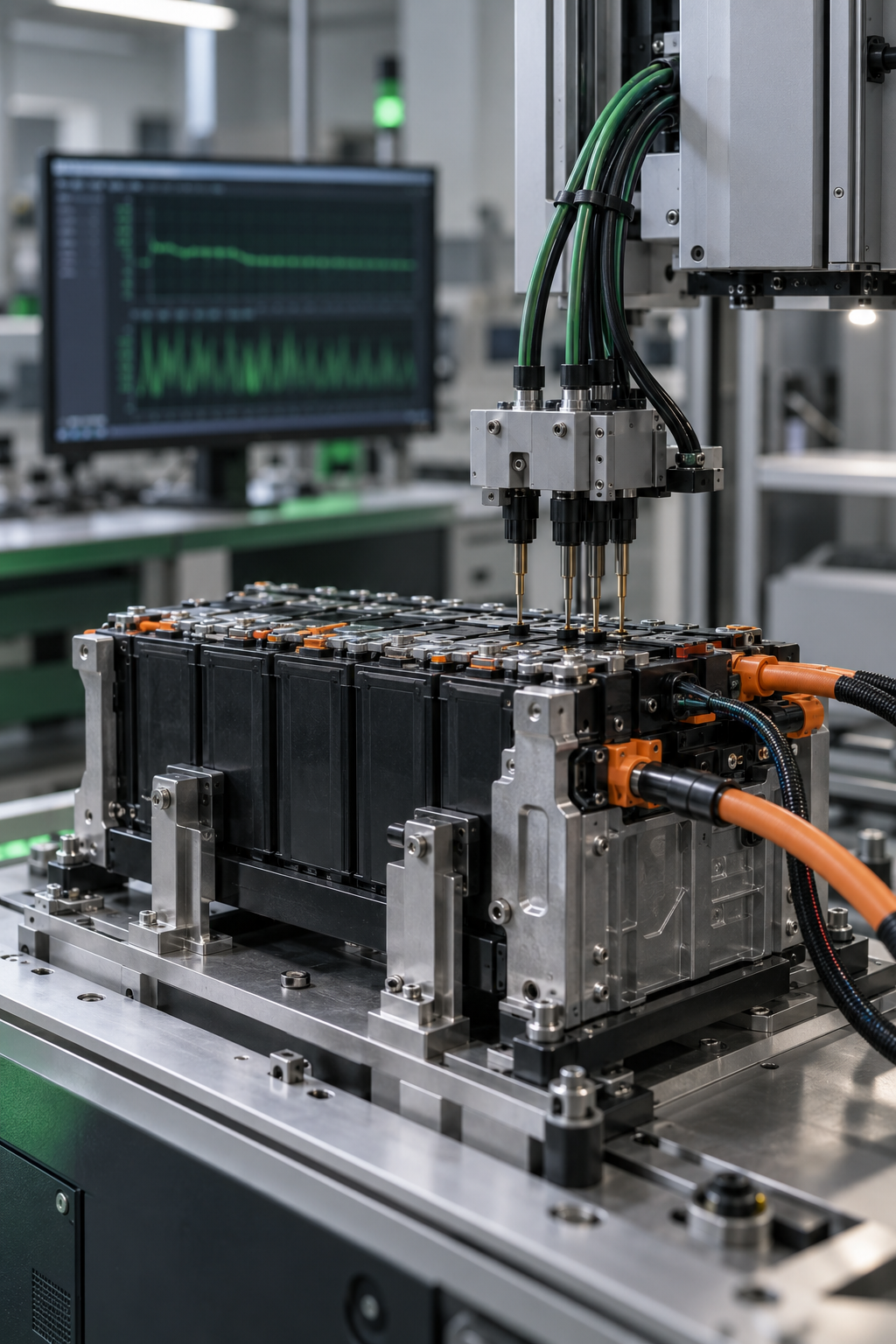
From incoming quality and Final testing to root cause and service diagnosis.
A practical operating model for investigating battery signals with production history, test traces and recorded field battery signals. The paper connects containment, hypothesis testing, process validation, controlled change and service handover to one traceable decision history.
Edition 3.2.1 · October 2026 · 15 pages
For quality, manufacturing, test engineering and field service teams
The useful result of analysis is an evidence-linked next action, an accountable reviewer and a way to verify the outcome.
01 / INDUSTRY PERSPECTIVE / 2026
Keep engineering and operating records connected.
IEA reports 1.2 TWh of EV battery deployment in 2025, nearly 30% growth, and more than 4 TWh of nameplate cell capacity. LFP exceeded 55% of EV battery deployment. [1]
Yield analysis needs denominators and comparability
Our interpretation: the operating question is which part of a measured loss the team can explain and address. Preserve first-test populations, rework routes and measurement versions. Compare similar product and operating conditions before attributing a shift to a supplier, machine or process.
Diagnosis should reach an approved next check
An alert only becomes useful when the responsible team can investigate it. The AI Engineer should assemble a timeline, identify data gaps, maintain competing hypotheses and propose a test that distinguishes them. Track unsupported recommendations and engineer corrections alongside investigation time.
Field learning should return to production decisions
A battery monitoring event can initiate a review of a production population, but association alone cannot establish the cause. Link the service case to the pack history and approved diagnostic procedure. Confirmed recurring findings can trigger process validation or a controlled engineering change with an explicit implementation scope.
02 / TESLA STORY / PUBLIC CONTEXT & SOLUTION ORIGIN
Tesla makes the lifecycle connection tangible.
Tesla describes battery cell and pack R&D, vehicle and storage products, connected service and remote diagnostics in its 2025 Form 10-K. It deployed 46.7 GWh of energy storage in 2025. [2]
Why this background matters
Our interpretation: a business that combines batteries, manufacturing, connected products and service needs to understand a unit across successive operating contexts. A supplier or test-method change can become relevant again when a field symptom appears. The central engineering question is how to preserve that evidence and its configuration history.
The origin of our Battery solution story
The supplied Tesla Battery Lifecycle Intelligence Platform presentation organizes the opportunity around supplier intelligence, new product introduction, manufacturing, equipment, battery health, service, remanufacturing and reusable knowledge. Its proposed foundation links source signals to analysis and reviewed actions. This publication carries that lifecycle structure into a clearer engineering and operations solution.
The scenario we can demonstrate
A changed test program and a new cell lot coincide with a final-test rejection spike. The AI Engineer assembles the evidence, keeps alternative causes visible and helps the team prepare a controlled comparison. Engineers then review the correction, release scope and follow-up checks. The investigation, validation and change-approval example later in this paper shows this sequence using fictional records.
The boundary of the story
The supplied deck labels itself a discussion demo with sample data. It does not establish an accepted Tesla deployment, an independently verified outcome or endorsement. We present the architecture as a proposed solution for this lifecycle context. Project-specific achievements require a confirmed, publishable customer record.
The lifecycle view connects the work of engineering, operations and service teams while retaining the source evidence behind each decision.
Concept illustration: connected engineering, manufacturing, service and recovery. No customer facility is depicted.
A shared foundation with several forms of analysis
The proposed system links product identity, configurations, material production history, test results and service events. On that foundation, the AI Engineer combines evidence retrieval, population comparison, time-series analysis and hypothesis tracking. Health and recovery models require their own agreed data, evaluation and technical scope.
Human decisions close the loop
Engineering accepts validation evidence. Quality approves containment and decision on affected units. Service engineers select approved diagnostic procedures. Change owners release governing versions. The resulting decision and effectiveness check return to a reusable knowledge layer, so the next team can see what worked and under which conditions.
Lifecycle stage
AI-supported work
Reviewable output
Supplier & new product introduction
Compare lots; reconcile imported evidence
Qualification scope and gate report
Production & testing
Relate process variation to raw test evidence
root cause analysis and validation package
Field & recovery
Connect symptoms to history and prior learning
Diagnostic case; scoped recovery review
04 / DAILY MANAGEMENT
Start with the decision behind the signal.
A plant generates many alarms and quality indicators. Their value depends on whether the team can establish what happened, define the affected population and choose a supported response.
An operational question
Begin with a specific question: why did a failure category increase, which lots need investigation or whether an action reduced recurrence. Avoid treating every available signal as equally actionable. Prioritize the decision that the responsible team can make.
Context before interpretation
Connect the serial number, product revision, material lot, process route, station and test-program version. Record timestamps consistently and expose missing links. A shift in the production mix or measurement conditions may explain an apparent trend.
Accountability after analysis
Every reviewed finding should lead to an owner, a decision on affected units and a check of the outcome. Keep containment, diagnosis, corrective action and release as distinguishable decisions. Preserve the evidence behind each step so another engineer can inspect it.
Working view
Primary use
Daily action board
Prioritize supported quality and equipment risks
Investigation workspace
Compare populations and review evidence
Corrective-action record
Track implementation and effectiveness
Engineering feedback
Update relevant changes and validation requirements
05 / SUPPLIER & PROCESS QUALITY
Follow variation through the product.
Incoming quality and manufacturing behavior should be examined together. A supplier or material change can coincide with other changes, so the investigation needs the product production history and the relevant operating context.
Incoming lot comparison
Compare cell and material characteristics across the selected lots and suppliers. Retain measurement methods and conditions. Show the size and completeness of each population, including whether a comparison uses sampled inspection or a full test population.
Process and yield context
Connect assembly, welding, bonding, dispensing, potting and other agreed operations to downstream results. Compare similar products and operating conditions. Inspect parameter changes, station events, maintenance actions and rework routes around the incident.
A reviewed containment scope
Produce a candidate list of affected lots and serial numbers with the evidence supporting inclusion. Quality reviews the scope, decision on affected units and any additional checks. Avoid broad supplier attribution when the evidence also supports process or measurement explanations.
Data element
Investigation role
Lot and production history for each pack
Defines product population and traceability
Product and process version
Separates different configurations
Station, shift and equipment events
Adds operating context
First-test, retest and rework records
Prevents outcome history from being flattened
06 / TESTING INTELLIGENCE
Check whether the measurement can be trusted.
Testing is a distinct part of the solution because test conditions, program revisions and equipment behavior influence the interpretation of the result. A pass/fail flag alone rarely provides enough context for a difficult investigation.
A complete test record
Link the original trace and calculated measures to the product serial, configuration, test method, program version, limit set and station. Include applicable equipment and calibration records. Preserve invalid or interrupted runs with explicit status.
Separate product and measurement hypotheses
Review whether a failure follows the product across comparable stations or is concentrated in a method, program or fixture. Use controlled checks and approved reference samples when appropriate. Any retest recommendation should state its purpose and acceptance criteria.
Interpret changes consistently
Maintain the effective version of the test method and limits. When a change occurs, evaluate comparability with previous data. Keep first-pass metrics separate from final acceptance after retest or rework so that reporting does not hide operational loss.
Evidence
Question it supports
Raw trace and failure category
What behavior triggered the result?
Program and limit revisions
Did the decision rule change?
Station and equipment condition
Could the measurement system contribute?
Original and repeat results
Was the behavior reproducible under controlled conditions?
07 / DIAGNOSIS & CORRECTIVE ACTION
Test possible causes before choosing a correction.
The investigation workspace should make uncertainty visible. It gathers evidence and helps structure the investigation, while engineers decide what is confirmed and what remains a hypothesis.
Define
Hypothesize
Test
Correct
Verify
Build an evidence-backed investigation
Define the incident, population and timeline before opening a fishbone investigation. Use people, method, machine, material, measurement and environment as prompts for competing hypotheses. Each branch needs supporting evidence, contradicting evidence, an owner and a next check. A populated fishbone is a working hypothesis register, not proof of root cause.
Confirm before permanent correction
Agree the check needed to distinguish the leading explanations. This may be a controlled test, record review or another engineering-approved verification method. Record its conditions, results and the responsible reviewer before promoting a hypothesis to a confirmed finding.
Verify effectiveness
Track containment and corrective actions independently. Define the observation population, duration and recurrence criteria before closure. If the outcome does not support effectiveness, reopen the relevant investigation step and preserve the earlier decision history.
Action record
Minimum content
Containment
Scope, owner, decision and decision on affected units
Cause verification
Method, conditions, evidence and reviewer
Correction
Approved action, effective version and implementation
Effectiveness
Observation period, recurrence criteria and result
08 / EQUIPMENT & OPERATING RHYTHM
Connect asset condition to product quality.
Equipment health becomes more actionable when the team can relate it to quality and production outcomes. Start with the equipment and failure modes where the available data supports an interpretable relationship.
Equipment-linked investigation
Connect station events, alarms and maintenance actions to product history and quality outcomes. Compare periods with similar product mix and conditions. Prioritize supported patterns rather than assuming every equipment signal predicts a failure.
Test-station consistency
Review differences in results across stations alongside calibration, method and fixture information. A station comparison should state whether the tested populations are comparable. Investigate suspected measurement differences through the test-engineering workflow.
Daily follow-through
Use a daily board to show the incident, impact, evidence confidence, owner, due action and current decision on affected units. Review overdue actions and effectiveness checks. Carry confirmed recurring issues into the maintenance plan or engineering change process.
Measure
Interpretation rule
Downtime
Use a consistent planned/unplanned definition
Equipment-related quality loss
Require a reviewed link to the incident
Action closure
Distinguish completion from verified effectiveness
Test-station variation
Compare equivalent configurations and conditions
09 / FIELD SERVICES / DIAGNOSTIC WORKSPACE
Connect field symptoms to engineering evidence.
Field diagnostics belongs in the same solution as factory quality. The workspace combines battery monitoring time series, fault events, service history and production history to prepare an inspectable diagnostic case.
Reconstruct the event before ranking causes
Start with pack identity, hardware and firmware revisions, timestamps and the reported symptom. Align voltage, current, temperature, state of charge and event codes on one timeline. Check units, sample intervals, clock offsets, missing channels and operating context. A gap in recorded battery signals must remain a gap rather than becoming an inferred healthy period.
Compare relevant behavior
For voltage divergence, compare channels under similar load, temperature and state of charge. For a thermal event, examine whether the sensor reading is credible alongside current, ambient conditions and available cooling status. For interrupted charging, align battery monitoring requests, limits and charger events. Compare with the pack's own history and a suitably matched reference population.
Prepare the next diagnostic action
The AI Engineer assembles a timeline, supporting and conflicting evidence, candidate explanations and a proposed check. A qualified service engineer reviews the action under approved service procedures. The case records what remains unknown and what result would strengthen or weaken each explanation. Confirmed findings feed back to production investigations and validation coverage.
Diagnostic output
Required content
Event timeline
Signals, faults and operating state with source links
Hypothesis register
Support, contradiction, missing data and next check
Service handover
Owner, approved action, result and escalation route
10 / FIELD DIAGNOSTICS / WORKED SCENARIO
A voltage complaint becomes a diagnostic case.
Illustrative service case FS-031: a customer reports intermittent power limitation. A voltage channel diverges during a high-load event. The workspace should explain the evidence and the next check, not jump directly to a cell-failure conclusion.
Assemble a synchronized timeline
Link the complaint to pack identity, software revision, fault timestamps, current, channel voltages and available temperatures. Confirm that channel numbering maps to the actual hardware. Mark a recorded battery signals gap before the event explicitly. The missing interval prevents a claim that the symptom began at the first recorded sample.
Keep several explanations open
Review imbalance, connection resistance, measurement-channel behavior and operating-condition effects as candidates. Compare the same channels at similar current and state of charge across previous events. Retrieve manufacturing final testing history and any related service actions. A normal final testing result is useful historical context, not proof that no field fault exists.
Plan a discriminating check and handover
The service engineer selects an approved diagnostic procedure that can distinguish a sensing issue from a repeatable electrical symptom. The draft case includes the expected observations under each hypothesis, required data and stop/escalation criteria from that procedure. After review, attach the result and update the hypothesis status; if evidence remains inconclusive, keep the case open.
Return confirmed learning to the lifecycle
A confirmed recurring pattern can trigger a population review by revision, supplier lot or service configuration. Engineering decides whether validation coverage or a controlled change is required. The diagnostic workspace links the service case to that decision so a later investigation can retrieve the rationale and limits.
Candidate explanation
Useful evidence
Limit to the inference
Operating-state effect
Matched current, temperature and Charge level
Unmatched conditions can confound
Measurement issue
Channel plausibility and approved check
A single event cannot confirm cause
Electrical issue
Repeatable behavior under approved test
Remote recorded battery signals alone may be insufficient
11 / WORKED EXAMPLE / INVESTIGATE, TEST AND APPROVE
From a failed test to a controlled release.
A new cell lot and a changed final testing program arrive in the same production window. The team must distinguish a product issue from a test-method issue before changing the release decision.
Detect
root cause analysis
Validate
Change
Verify
01 / Detect and contain
In this fictional example, 24 of 240 packs are rejected on first test. Each of three stations tests 80 packs: Station 1 flags 3, Station 2 flags 18 and Station 3 flags 3. Quality opens the test-failure investigation, preserves the original results and reviews the affected serials. Containment is a temporary decision on affected units, not proof of the cause.
02 / Investigate the competing explanations
Both cell lots show 12 rejects out of 120 packs. By program version, v2.3 shows 4/120 and v2.4 shows 20/120. This redirects attention to measurement, but the observational groups may differ. Raw traces suggest that v2.4 samples before the response has settled; a matched test is still required.
03 / Validate the proposed correction
The validation study uses the same 12 known-good packs from two cell lots on two stations, across three program versions: 72 test runs. Each station records 0/12 false rejects with v2.3, 6/12 with v2.4 and 0/12 with corrected v2.5. Restoring the wait before measurement removes the pattern in this controlled sample.
04 / Release, then verify closure
After engineering review, the approved test-method change defines deployment of v2.5 to Station 2, a named implementation owner and rollback to previously approved version v2.3. Three subsequent lots of 100 checks show no repeat false rejects under the agreed check. The team closes the test-failure investigation with the validation and change records attached. These 300 checks do not establish zero defects or universal capability.
12 / IMPLEMENTATION / 12-WEEK REFERENCE PLAN
Measure the pilot against real engineering work.
A practical pilot evaluates whether the workspace helps a real team assemble reliable evidence and reach a reviewed decision. The schedule below is a planning example and depends on data access and scope.
Agree the baseline before the trial
Select one bounded workflow and an accountable sponsor. Define eligible cases, start and end events, excluded records and a comparison period. Use historical cases with reviewed outcomes for replay, and reserve separate cases for evaluation. Include difficult cases with missing evidence rather than selecting only successful demonstrations.
Run a shadow period with explicit review
Compare generated evidence and suggested next steps with engineer-reviewed records. Log unsupported claims, missed links, incorrect version joins and time spent correcting the output. In the shadow period, recommendations do not change production decision on affected units automatically. A pilot is useful when it reveals both where the workflow helps and where the data or method is inadequate.
Define the expansion decision
Review median elapsed time to an accepted evidence package, source-link completeness and the fraction of recommendations requiring material correction. Keep quality outcomes separate from efficiency measures. Compare similar case complexity and disclose changes in staffing or product mix. Expand only after the team accepts the evidence, handover and review controls.
Stage
Working result
Review gate
Weeks 1-2
Scope, owners, baseline and data mapping
Identities and evaluation rules accepted
Weeks 3-6
Historical replay and evidence retrieval
Errors assessed; sources traceable
Weeks 7-10
Reviewed shadow workflow
Owners can use and challenge outputs
Weeks 11-12
Evaluation and next-scope proposal
Proceed, revise or stop with reasons
PUT THE FRAMEWORK TO WORK
Readiness checklist & sources
Choose one failure category or field symptom with reviewed historical cases.
Link serials, lots, stations, test revisions and available battery monitoring events.
Define the containment, service escalation and change approval owners.
Agree recurrence criteria and observation scope before case closure.
Sources and publication status
[1] Industry context
IEA (2026), Global EV Outlook 2026, Electric vehicle batteries. Public market context; accessed 5 October 2026. https://www.iea.org/reports/global-ev-outlook-2026/electric-vehicle-batteries
[2] Tesla public background
Tesla, Inc., 2025 Form 10-K, Business and Management overview. Accessed 5 October 2026. https://www.sec.gov/Archives/edgar/data/1318605/000162828026003952/tsla-20251231.htm
[3] Solution origin
Tesla Battery Lifecycle Intelligence Platform.pptx, supplied 27-slide discussion deck; and supplied IndustrialMind lifecycle PDF. Proposed scope and sample data, not proof of customer deployment.
[4] Publication
IndustrialMind Battery Solution Series, edition 3.2.1, October 2026. Industry implications are our analysis. All worked investigations are fictional. Generated images depict concepts, not customer facilities.
Term
Meaning in this paper
Final testing
Checks completed before a battery leaves production
Root cause analysis
Investigating why a problem happened and testing the explanation
8D report
An eight-step record of the problem, correction and follow-up
Battery monitoring
Recorded voltage, temperature, current and charge level
Bring your next battery challenge.
Discuss the workflow, evidence and approval steps for your team.
 Download PDF ↓